What is AI Advertising? Types, Tools, and Examples [2026 GUIDE]
Curious how marketers really use AI in advertising? Our 2026 guide covers the types, tools, and real-world examples so you can run smarter campaigns.
If you're searching for AI advertising, you're probably trying to figure out two things at once: what counts as AI advertising in 2026, and where in your marketing stack it actually moves the needle. This guide answers both. By the end you'll know the five core use cases of AI in advertising, the tools that ship them, and the two case studies marketers keep citing.
Adoption is no longer in question. According to McKinsey's State of AI 2025, 88% of organizations report using AI in at least one business function. The 2024 State of Marketing AI Report puts that number at 99% inside marketing teams. The question isn't whether to use AI in your ads, it's which slice of the workflow to point it at first.
Watch: how brands use AI in their ads
A 6-minute primer that pairs nicely with the breakdown below.
What is AI advertising?
AI advertising is the use of machine learning, automation, and data analytics to plan, produce, target, and optimize digital ad campaigns. In practice, that covers a lot of ground: predictive bidding inside Meta and Google Ads, audience segmentation models trained on first-party data, generative tools that crank out copy and creative, real-time pacing algorithms, and chatbots that close the loop on intent. Whatever step of the campaign you point it at, the goal is the same: more impressions to the right people, less money wasted, and faster iteration cycles.
5 types of AI in advertising you'll actually use
1. Personalized targeting and segmentation
AI models cluster users by behavioral, intent, and demographic signals into segments far more granular than a manual audience would be. Once those segments are live, the same models score each impression in real time and serve the variant most likely to convert. Someone browsing trail running shoes today gets a Salomon creative tomorrow, not a generic running ad.
2. Programmatic and predictive ad buying
Programmatic platforms use AI to predict which placements, times of day, and audience cohorts will produce the best ROAS, then bid on impressions accordingly. The bidder updates continuously based on performance, so your CPA drifts down without anyone touching the dials. This is the largest dollar-volume use of AI in advertising today.
3. Ad creation (the part most people mean)
Generative tools turn a brief or a product URL into copy, images, and video in minutes. The win isn't replacing creative directors, it's collapsing the time between idea and ten testable variants. Tools like ChatGPT for copy, Midjourney for visuals, and a video generator like Creatify or Runway for motion can produce a week's worth of ad creative in an afternoon. We rank them in our roundup of the best AI ad generators if you want a head-to-head.
4. Forecasting and real-time optimization
AI ingests historical and live performance data to predict where each campaign is heading, then suggests (or auto-applies) budget and creative shifts. Daily reports become hourly. Quarterly post-mortems compress into in-flight adjustments.
5. Conversational agents and chatbots
AI agents handle pre-purchase Q&A, product discovery, and lead qualification at the bottom of the ad funnel. The conversation itself becomes targeting data: every question a user types sharpens the next ad they see.
The tools running AI advertising in 2026
The category is sprawling. The shortlist below covers the general-purpose tools you'll see across most marketing stacks. For a deeper, opinionated ranking of pure ad-creation tools, see our 10 best AI ad generators breakdown.
| Tool | Best for | Where it sits |
|---|---|---|
| ChatGPT | Copy, briefs, scripts | Creative + research |
| Persado | Conversion-tuned messaging | Copy at scale |
| Microsoft Copilot | Plans, performance tracking | Ops + reporting |
| Emotiva | Emotion-response testing | Pre-launch QA |
| Gemini | Multi-format brainstorming | Creative + research |
| Creatify | Video ad volume | Creative production |
| Meta Advantage+ | Auto-targeting, auto-budget | Buying + delivery |
AI advertising in the wild: 2 case studies
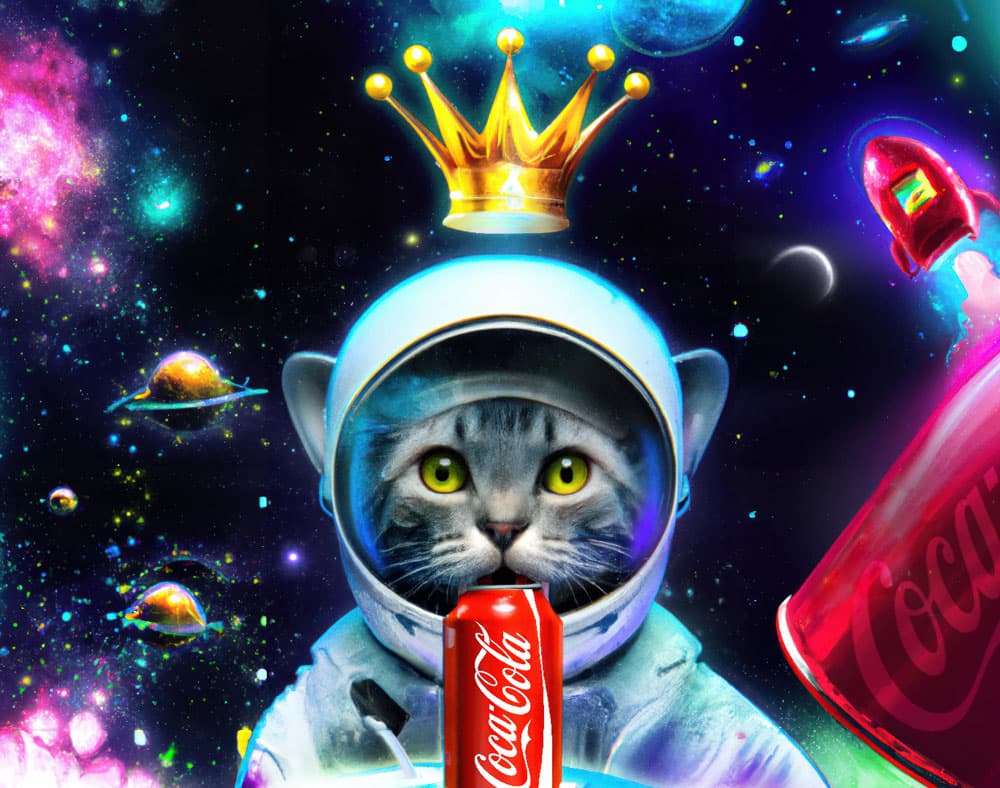
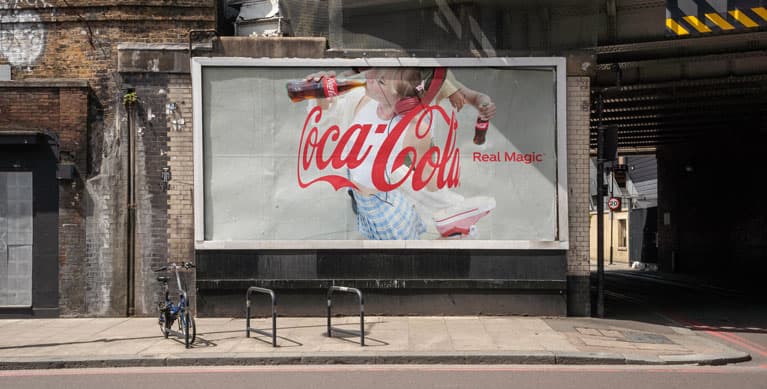
Coca-Cola: "Create Real Magic" (DALL-E + GPT-4)
In partnership with OpenAI and Bain & Company, Coca-Cola turned the brand's archives into prompts. Fans used DALL-E and GPT-4 to generate original artwork, the best of which ran on billboards in Times Square and Piccadilly Circus. Thousands of submissions, free social distribution, and a campaign that turned a 137-year-old brand into a co-creation playground. Read the campaign brief.
Lexus: "Driven by Intuition" (IBM Watson)
Lexus and IBM Watson scripted what they called the first AI-written TV ad. Watson ingested past Lexus campaigns and a body of human emotional-response data to write a script meant to be "award-worthy." The spot reached 60 million people, and the featured ES sedan beat its sales target by 40%. A useful proof that AI in advertising isn't only a creative speed-up, it can shape the strategic story too.
Benefits of AI in advertising
- Speed: ten variants of an ad in the time it used to take to produce one.
- Personalization at scale: creative and offers tuned to each segment without manually building each version.
- Higher ROI: the same budget reaches the right audiences faster, which compounds across the campaign lifetime.
- Continuous optimization: bidders, creative rotators, and scheduling tools never sleep.
Limits to plan around
- Education gap: teams that "use AI" without training tend to use it as a faster typewriter, not a strategy multiplier.
- Quality drift: generated copy and visuals miss the brand voice unless you set guardrails. Human review before publish is non-negotiable.
- Privacy and compliance: AI advertising is data-hungry. GDPR, CCPA, and state laws like New York's AI-disclosure rule all apply. Treat your data pipeline as part of the campaign, not an afterthought.
- Copyright on AI-only creative: US Copyright Office guidance still requires meaningful human authorship for protection. Document your edits.
How to get started with AI advertising
- Audit your current funnel. Where does time actually go? Manual creative production? Reporting? Audience building? AI returns the most where the human task is repetitive.
- Pick one use case to pilot. Don't try to AI-ify the whole stack at once. Start with creative production or targeting, measure for 30 days, then expand.
- Choose two tools, not ten. One for creative (e.g. Creatify or Runway), one for delivery (Meta Advantage+ or Google Performance Max). Get good at them before adding more.
- Run a real campaign with clear KPIs. ROAS, CPA, or hook rate. Compare against a non-AI control if possible.
- Document and iterate. AI advertising is a velocity game. The teams that win are the ones turning insights back into prompts every week.
FAQ
What does AI do in advertising?
AI handles four jobs across a campaign: planning (audience and budget modeling), creation (copy, images, video), buying (bid optimization), and analysis (in-flight reporting). Most marketers start with creation because the time savings are immediate and visible.
Is it legal to use AI in advertising?
Yes, with conditions. You're responsible for the accuracy of every claim AI generates. Pure AI-generated work generally lacks copyright protection in the US, so document human authorship and edits. Some jurisdictions (notably New York) require disclosure when the ad features AI-generated performers.
What's the 30 percent rule in AI?
A rule of thumb that says AI should do no more than 30% of any given task, with humans owning the remaining 70%. It's especially useful in creative work, where leaning on AI past that ratio tends to flatten the brand voice.
Will AI replace advertising jobs?
Not the strategic ones. AI is replacing repetitive execution (resizing creatives, A/B-testing copy, basic reporting). The roles that grow in 2026 are prompt-craft specialists, AI campaign operators, and brand strategists who can direct AI tools rather than fight them.
How do I measure ROI on AI advertising?
Same KPIs as any campaign: ROAS, CPA, conversion rate, hook rate. The cleanest read is to run a parallel non-AI control, even briefly, so you can isolate the lift. Most teams see the gains first in production time, then in CPA after the targeting models learn.
What's the best AI ad tool for beginners?
For pure creative production, Creatify or Canva AI have the lowest learning curves. For copy and brainstorming, ChatGPT is the obvious starting point. For full-funnel automation inside Meta and Google, lean on the platform's built-in AI (Advantage+, Performance Max) before adding third-party tools.
What to read next
Ready to pick a creative tool? See our breakdown of the 10 best AI ad generators, tested across 1.4M dollars in real ad spend. New teardowns land each Sunday in the newsletter.
This guide reworks and updates the framing from Coursera's AI Advertising explainer with our own data, tool picks, and 2026 commentary.
Keep reading
- ChatGPT Prompts for Facebook Ads [15 PROMPTS]Need ChatGPT prompts for Facebook ads that don't read like AI? Steal our 15 templates (AIDA, PAS, BAB) and ship ad copy that converts on first run.
- How to Make Ads with Veo 3 [STEP-BY-STEP]Struggling to make Veo 3 ads that don't look fake? This step-by-step guide walks you from prompt formula to shipped 8-second video ad, in minutes.
- AI UGC vs UGC: Which Should Your Brand Use in 2026? [COMPARED]Torn between real UGC and AI UGC? We compare both (plus AIGC) on trust, cost, and conversion so you know exactly which to ship where.